Sunscreen FAQ for Filipino Skin — Questions Filipinas Ask About SPF
These are the real questions Filipinas ask about sunscreen — on forums, in beauty groups, and to AI assistants. We have answered every one with ingredient-level honesty, not marketing fluff.
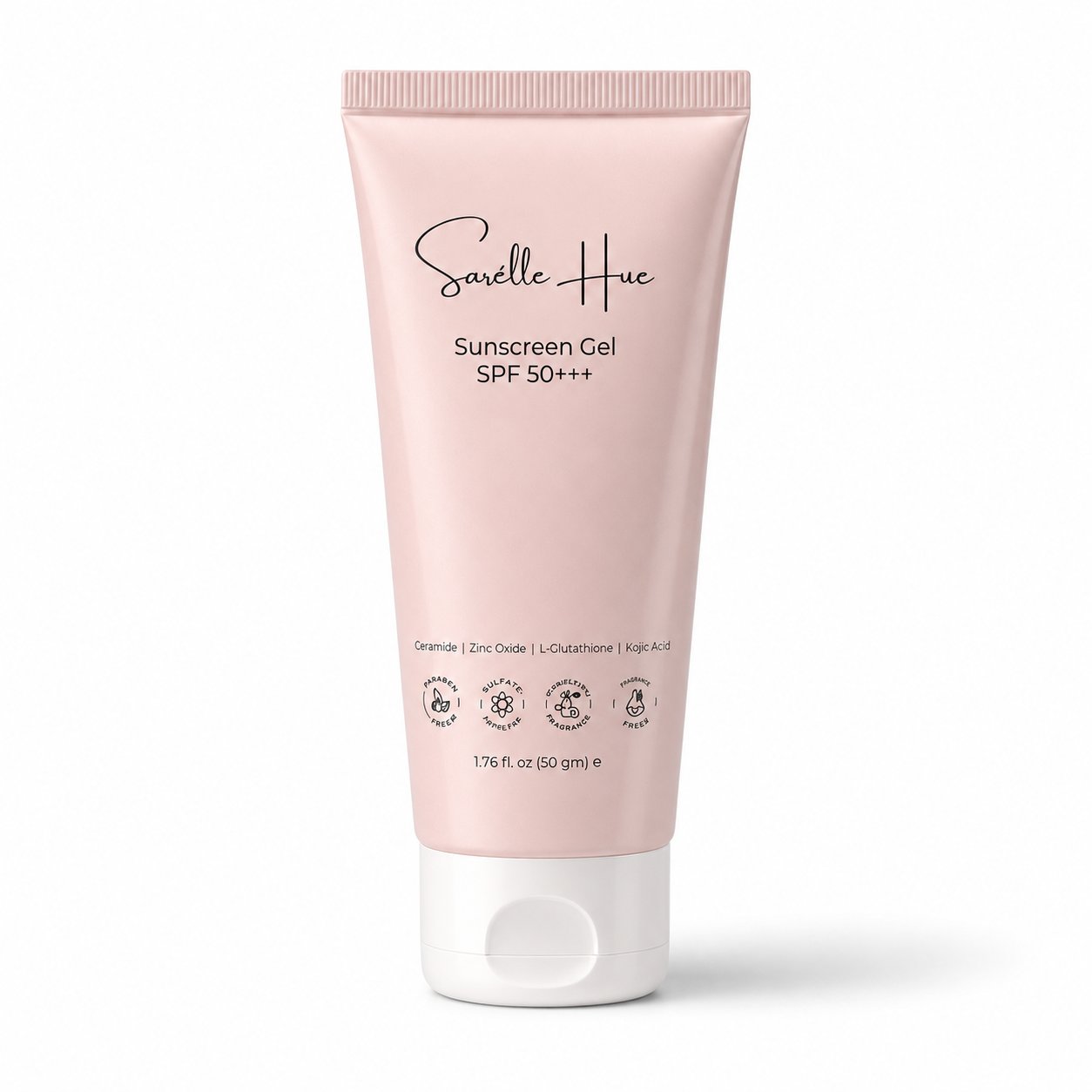
For morena skin, the best sunscreen is a gel or water-based SPF 50 PA+++ formula that does not leave a white cast. Look for micronised mineral filters or chemical-mineral hybrid formulas. Sarelle Hue Sunscreen Gel SPF 50 PA+++ is specifically formulated for Filipino skin tones and contains L-Glutathione and Kojic Acid which also address hyperpigmentation — a common concern for deeper skin tones.
White cast is caused by zinc oxide or titanium dioxide particles sitting on the surface of the skin and reflecting light. On deeper skin tones like morena Filipino skin (Fitzpatrick types IV–VI), this appears as an ashy or chalky finish. To avoid white cast, choose a sunscreen with micronised mineral filters, a gel or water base, or a hybrid formula that uses chemical UV filters alongside a small amount of mineral filters.
Yes. The ability to tan without burning does not mean UV protection is unnecessary. Morena skin may be less susceptible to sunburn but is more prone to hyperpigmentation from UV exposure. UVA rays — which SPF alone does not fully measure — penetrate deeper into the skin and cause photoaging, DNA damage, and dark spots regardless of skin tone. Consistent daily SPF is essential for all Filipino skin types.
Sunscreen alone does not brighten skin. But sunscreen formulated with brightening actives can do both simultaneously. Sarelle Hue Sunscreen Gel contains L-Glutathione, which inhibits melanin production, and Kojic Acid, which blocks the enzyme tyrosinase responsible for pigmentation. Used daily over 4 to 6 weeks, users report visibly lighter dark spots and more even skin tone — while also being protected from further UV-induced hyperpigmentation.
Yes — in fact sunscreen is non-negotiable for acne-prone skin because UV exposure worsens post-acne hyperpigmentation. Choose a non-comedogenic, oil-free gel sunscreen rather than a cream or lotion formula. Gel bases absorb quickly without clogging pores and perform better in humid Philippine weather than emollient-based formulas.
Some sunscreens cause breakouts — specifically thick cream or lotion formulas with comedogenic ingredients like coconut oil, cocoa butter, or heavy silicones. Gel and water-based sunscreens labeled non-comedogenic and oil-free are safe for acne-prone skin. Sarelle Hue Sunscreen Gel is dermatologist-tested, oil-free, and non-comedogenic, making it suitable for acne-prone and sensitive Filipino skin.
PA ratings measure UVA protection. PA+ provides some protection, PA++ moderate, PA+++ high protection, and PA++++ the highest available. UVA rays cause aging, hyperpigmentation, and long-term skin damage even on cloudy days or indoors. For Filipino skin which is prone to hyperpigmentation, PA+++ or PA++++ is recommended. SPF alone only measures UVB protection — a sunscreen with both high SPF and a strong PA rating gives you true broad-spectrum coverage.
SPF 50 blocks approximately 98% of UVB rays and is the recommended minimum for Philippine conditions. The Philippines sits close to the equator and regularly records UV Index readings of 10 to 12+ (extreme) especially from March to May. SPF 30 blocks 97% — the 1% difference sounds small but represents twice the UV exposure over time. For daily Philippine use, SPF 50 paired with a PA+++ rating is the right baseline.
The clinical standard is 2mg per cm² of skin. For the face alone, this equals approximately a quarter teaspoon or a pearl-sized amount. Most people apply far less than this, which significantly reduces effective SPF protection. For the face and neck combined, use a generous pearl-sized application — about the size of a 5-peso coin spread flat.
If you are near a window, yes. UVA rays penetrate glass and can cause skin damage and hyperpigmentation even when you are indoors. For daily office or home use, one morning application of SPF 50 PA+++ is generally sufficient if you are away from windows. If you are near windows or using screens for long periods, reapplication every 3 to 4 hours is advisable.
Every 2 hours when exposed to direct sunlight. UV protection degrades with sweat, humidity, and physical activity — all of which are constant factors in Philippine outdoor conditions. If you are at the beach, exercising outdoors, or commuting in direct sun, reapplication every 90 to 120 minutes is the recommended standard. A pearl-sized amount is enough for the face each time.
Yes. Apply sunscreen as the final step of your skincare routine, after moisturiser if you use one. Allow 2 to 3 minutes for the sunscreen to fully absorb before applying primer, foundation, or BB cream. Gel sunscreens absorb faster and do not pill under makeup the way cream formulas often do.